
Monday, October 30, 2006

The Durocco


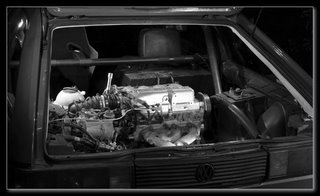
Anson added an additional 16v drivetrain to the rear of his 16v Scirocco. Sure it's freaking awesome, but what exactly is "green" about it?

As a hobby car, it racks up far fewer miles than a commuter. A car that spends most of its time parked or in pieces really uses very little fuel at all. Also (and this is probably stretching), it represents reusing materials that otherwise would go to scrap. (Yeah, that's the ticket!)

Anson does also drive a WVO-converted Mercedes.

In any case, it's unbelievable. Check out the videos to see him walk a Porsche 911 and drive sideways for minutes at a time.

Monday, October 23, 2006

Chevy Tahoe EPA MPG numbers optimistic?

I noted in a previous post that although the 2007 Tahoe's EPA mileage numbers aren't exactly stellar, they're far better than they were only a few years ago. The 2007 Tahoe 2wd 5.3 is EPA rated at 16 MPG city / 22 MPG highway.

But I may have spoken too soon about the apparent frugality of the new 'Hoe. Reports on the Web are reflecting real-world mileage figures that are significantly poorer than the advertised 16/22.

MPH Online's Blog notes

I just managed a paltry 16.3 mpg in a 2007 Tahoe on my 50-mile (each way) daily commute, 90 percent of which is highway driving. The problem? The 4-wheel drive Tahoe claims a fuel economy of 15 city, 22 highway. The last Tahoe I drove, which I took to Chicago, only gave back 14 miles per gallon. That truck had barely any miles on it and was a preproduction unit, so I was willing to give it the benefit of the doubt. But that's not the case here since the more recent 'Hoe was well above its break-in miles

A thread on Chevrolet Forum asks users of their MPG, assuming 50-75% highway driving:


Viperjuice posts: well i've been driving back and forth to work some city some highway and i average about 15.. i had it on the Masspike, which is alot of up and down highway and i reset it and was getting only 16.8.. honestly i'd go with the trailerblazer with the dod v8.. lighter truck, therefore better mileage.. and they defenitly are much better than those l6 engines.

-------------
Swatson1 posts: I'm getting 13.7 mpg overall average in my LTZ. I drive about the same percentage of hwy and city miles. I'm severely dissapointed in the gas mileage. It seems to make a difference whether you run the a/c or not. I'm in texas where it is hot, so I run it a lot.

-------------

ZX1100F1 posts: I have a 4X4 model with 4.10 gears, I get about 16.5 MPG avg with about 50/50 Hwy/City driving, I just turned 3K miles last week.
I took a trip the first week I owned it and avg'd a little over 18 Hwy, got 455 miles one tank before the light came on and I filled it up


You get the picture. So what's the problem? Active Fuel Management. My own theory is that the software algorithm behind this feature on the 5.3 Tahoe is optimized for the EPA test cycle but not necessarily for real-world driving conditions. Or perhaps the software has been revised between the test and the release of the vehicle. Or heck, maybe GM slipped the EPA a ringer.

In any case, I had considered the Tahoe despite its borderline-lousy MPG, for its utility and comfort. A herniated disc requires me to drive a vehicle with big seats, a high seating position, and plenty of legroom. But if the mileage is as bad as user reviews have indicated, the deal is off.

Tuesday, October 17, 2006

Design Belies Process: Homer's Dream Car


In the Simpsons episode 7F16, Oh Brother Where Art Thou, Grampa Simpson reveals to the family a long-hidden secret: Homer has a half-brother. Homer's brother, Herb Powell, is the head of the Powell Motors car company, and decides that as an "average" American, Homer is the perfect designer for a car catering to other "average" Americans. Homer is given free design reign and all ends poorly. Homer's car is finned monstrosity featuring three horns that play "La Cucaracha" and a separate sound-proof bubble dome for the children (featuring optional restraints and muzzles.) Powell Motors is doomed.

I've often used this scenario as an example of not asking users the right questions. By asking "Do you wants" instead of "Tell me abouts," you're leveraging the user's design expertise and not your own.

Consider any design suggestion a user makes not as a design requirement, but as a reflection of a problem that needs to be solved. Does the user really want three horns that play La Cucaracha, or does he want to be noticed? And never, ever ask yes or no questions. If you ask a parent "How about a soundproof bubble for the children with optional restraints and muzzles," of course the parent is going to say yes.

Ultimately however, the episode's punchline isn't that Homer is a poor designer and that his efforts have yielded a monstrosity. Homer was tasked with designing a car to meet his own needs and desires, and he succeeded. The punchline is that his half-brother Herb mistakely assumed that as a consumer, Homer was representative of anyone other than Homer.

To avoid releasing a Homer, a team must:
  1. Inform the design with information gathered from real, representative users. What are the users' goals? What are their characteristics? What challenges do they face with similar products?
  2. Design the product to meet these considerations.
  3. Validate the design decisions by watching real users interact with the product.
Success lies in designing a product that addresses the problems that many real users wish to solve.
Monday, October 16, 2006

Silverado ads get "strong reactions" from viewers, hippies

"I'm meeting you halfway, you stupid hippies." (Futurama 2acv03, A Head in the Polls)

First, I'd like to preface this post by saying that I like full-size trucks, especially Chevy trucks. If they were more economical and ecologically sound to operate, I'd consider buying one. But apparently I'm a bad American, perhaps even a hippie.

So I tried to pause my DVR during an airing of a Chevrolet "Our Country. Our Truck" commercial last night in an attempt to catch a glimpse of the new Silverado, but I couldn't hit pause fast enough to catch that frame.

John Mellencamp sings "This is Our Country" (I kid you not) over a montage of pure Americana (R). Rosa Parks, the Twin Towers, Richard Nixon, Charles Whitman - flip, flip, flip. It's not that the spot exploits 9/11 or any other event or series of events in American history. It's that the spot exploits 9/11 and every other event and series of events in American history. It's hamfisted, manipulative crap that makes "We Didn't Start the Fire" appear sincere in comparison.

Autoweek quotes Bill Ludwig, the "Chief Creative Officer" of Campbell-Ewald, the advertising firm responsible for this piece of mungus:


Ludwig says he anticipated that the Silverado spot would generate complaints. The commercial is about America "and the knocks we have taken and pulling ourselves up by the bootstraps," he says. "Anytime you are provocative, you are going to elicit some provocative responses.

"If you want to make a statement that rings true with the majority of people, you are going to piss off some people. There are a lot of cynical people out there who don't react well to this, and a lot of people who will never get behind the wheel of a pickup.

"So let them get into their Volvo sedans and complain about this spot that they see as exploitive," he says. "This is not for them. The biggest risk you can take is to play it safe."

Exactly what GM needs right now! Someone to challenge potential buyers to not buy their products. So you hear that, dissenters and Volvo sedan drivers? GM's make-or-break product is not for you!

Sunday, October 15, 2006

Tips on recycling old desktop computers

As awareness of the presence of toxins like lead, zinc, and cadmium increases, so does interest in recycling old desktop computers and electronic products. This article

First, donate the equipment to charity if possible. My only caveat would be to remove and destroy a PC's hard drive before donating the machine. I realize that a PC without a hard drive is much less useful to a charity than one that actually works, but this is the best way to know that your personal information won't end up in the wrong hands through an auction or thrift store sale.

Second, consider recycling e-waste like old desktop computers. Call your city government to see if your local environmental waste ("sanitation") department has an electronic waste recycling program.

See the Basel Action Network's E-Stewards for a list of responsible e-cyclers that have agreed to the most rigorous criteria for sustainable electronics recycling.